The Architect’s Perspective: Scalability without the Overhead
In the world of high-performance backend engineering, there is a common paradox: How can a platform that runs on a single thread outperform multi-threaded environments like Java or .NET in handling thousands of concurrent users?
To the uninitiated, a single thread sounds like a bottleneck. To a senior engineer, it represents a radical shift in efficiency. Node.js doesn't win by doing everything at once; it wins by never waiting for anything.
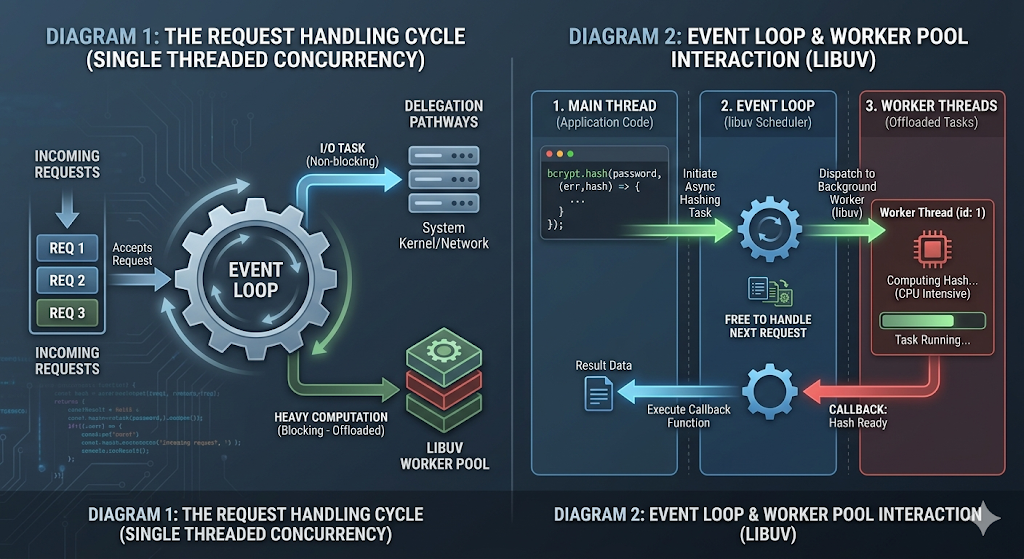
1. The Single-Threaded Nature of Node.js
Unlike traditional servers that spawn a new thread for every incoming request (consuming significant memory for each), Node.js operates on a single Main Thread.
The Analogy: Think of a world-class chef in a small kitchen. A multi-threaded server is like hiring a new chef for every single customer soon, the kitchen is too crowded to move. Node.js is a single, highly efficient chef who takes an order, puts the steak on the grill, and immediately turns to take the next order while the steak cooks itself.
2. The Heart of the Machine: The Event Loop
The "magic" that keeps the chef moving is the Event Loop. Its job is simple but critical: monitor the execution stack and the task queue. If there is work to do, do it. If a task requires waiting (like a database query), offload it.
The Workflow:
A request arrives.
The Event Loop picks it up.
If the request involves I/O (Database, File System, Network), Node.js delegates it to the system’s kernel or a background worker.
The Event Loop is now free to handle the next request.
3. Concurrency vs. Parallelism
It is vital to distinguish between these two concepts.
Parallelism is doing two things at the exact same time (multiple CPUs).
Concurrency is managing many tasks at once by switching between them (the Chef).
Node.js provides massive concurrency. While it is processing your login request, the background workers are busy fetching a profile picture. When the picture is ready, a "callback" is placed in the queue, and the Event Loop picks it up when it has a free millisecond.
4. The Worker Pool (Libuv)
When people say Node.js is "single-threaded," they are technically only talking about the code you write. Under the hood, Node.js uses a library called Libuv, which maintains a Worker Pool.
Expensive tasks like cryptographic hashing or heavy file compression—are sent to these background threads. This ensures that the "Main Thread" (the Event Loop) is never blocked by a "heavy" computation.
5. Why Node.js Scales So Well
Because Node.js doesn't create a new thread for every connection, it has an incredibly low memory footprint. It can handle 10,000 concurrent "hanging" connections (like WebSockets) with the same amount of RAM that a multi-threaded server might use for just 100.
The Result: You get high throughput with minimal infrastructure costs.
Takeaway
Node.js is built for I/O-intensive applications chat apps, streaming services, and real-time APIs. However, because of its single-threaded nature, it is a poor choice for CPU-intensive tasks (like video encoding) on the main thread, as that would "block the loop" and prevent any other requests from being handled.