The Great Expansion and Collection: Spread vs. Rest in JavaScript
In modern JavaScript (ES6+), the triple-dot syntax (...) is arguably one of the most versatile tools in a developer's arsenal. However, it’s a source of frequent confusion because it performs two diametrically opposed operations depending on where it’s used.
As engineers, we need to distinguish between expanding data (Spread) and collecting data (Rest). Let’s break down the mechanics.
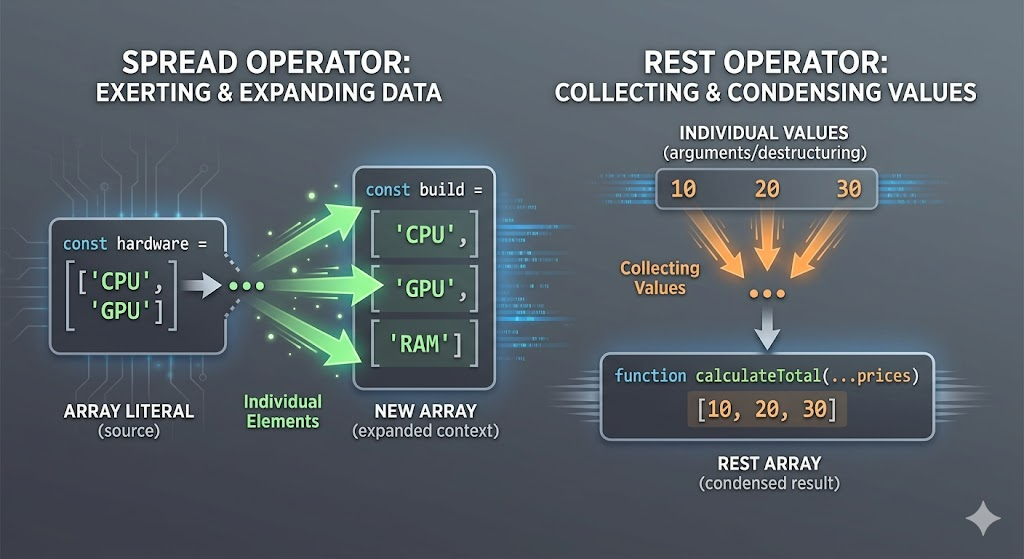
1. The Spread Operator: The Great Expansion
The Spread operator is used to "unpack" or expand an iterable (like an array or an object) into its individual elements.
The Concept: Think of it as taking the contents out of a box and laying them out on the floor.
Spread with Arrays
We use this most commonly for cloning or merging data without mutating the original source.
const hardware = ['CPU', 'GPU'];
const fullBuild = [...hardware, 'RAM', 'SSD'];

console.log(fullBuild); // ['CPU', 'GPU', 'RAM', 'SSD']
Spread with Objects
In the context of state management (like React), we use spread to update objects while maintaining immutability.
const user = { name: 'Alex', role: 'Dev' };
const updatedUser = { ...user, role: 'Senior Dev' }; // Overwrites role
2. The Rest Operator: The Great Collection
The Rest operator looks identical to spread, but it occurs on the "receiving" end of an operation. It collects multiple elements and "condenses" them into a single array.
The Concept: It handles the "rest" of the values that weren't specifically picked out.
Rest in Function Parameters
This allows functions to accept an indefinite number of arguments.
function calculateTotal(...prices) {
  return prices.reduce((acc, curr) => acc + curr, 0);
}

calculateTotal(10, 20, 30); // prices becomes [10, 20, 30]
Rest in Destructuring
When you want to extract specific values but keep the remaining data together:
const [lead, ...team] = ['Alex', 'Jordan', 'Taylor', 'Casey'];

console.log(lead); // 'Alex'
console.log(team); // ['Jordan', 'Taylor', 'Casey']
3. Key Differences at a Glance
| Feature | Spread Operator | Rest Operator |
|---|---|---|
| Action | Expands/Unpacks | Collects/Condenses |
| Location | Where values are expected (e.g., function calls, array literals) | Where values are defined (e.g., function params, destructuring) |
| Result | Multiple individual elements | A single array containing the items |
4. Practical Use Cases for Industry Leaders
Immutability: Spread is the standard for copying arrays and objects to avoid "side effects" where changing one variable accidentally changes another.
Flexible APIs: Using Rest in function parameters allows you to build highly flexible utility functions that don't care how many arguments the user passes.
Component Props: In frameworks like React, we often use spread to pass a large object of properties down to a child component effortlessly.
The "Senior" Insight: Performance and Placement
The Rest operator must be the last element in a destructuring pattern or a function parameter list. You cannot have "trailing" elements after a rest operator, as the engine wouldn't know when to stop collecting.
Furthermore, while spread is convenient, be wary of spreading massive arrays (millions of elements) into function calls, as you can hit the "Maximum call stack size exceeded" error. In those cases, traditional loops or specialized buffer methods are your best friend.
Final Thought
Whether you are unpacking a configuration object or collecting a variable list of API parameters, the ... syntax is about managing the shape of your data.
In your current codebase, are you using spread to ensure data integrity, or are you still relying on Object.assign() and Array.concat()?